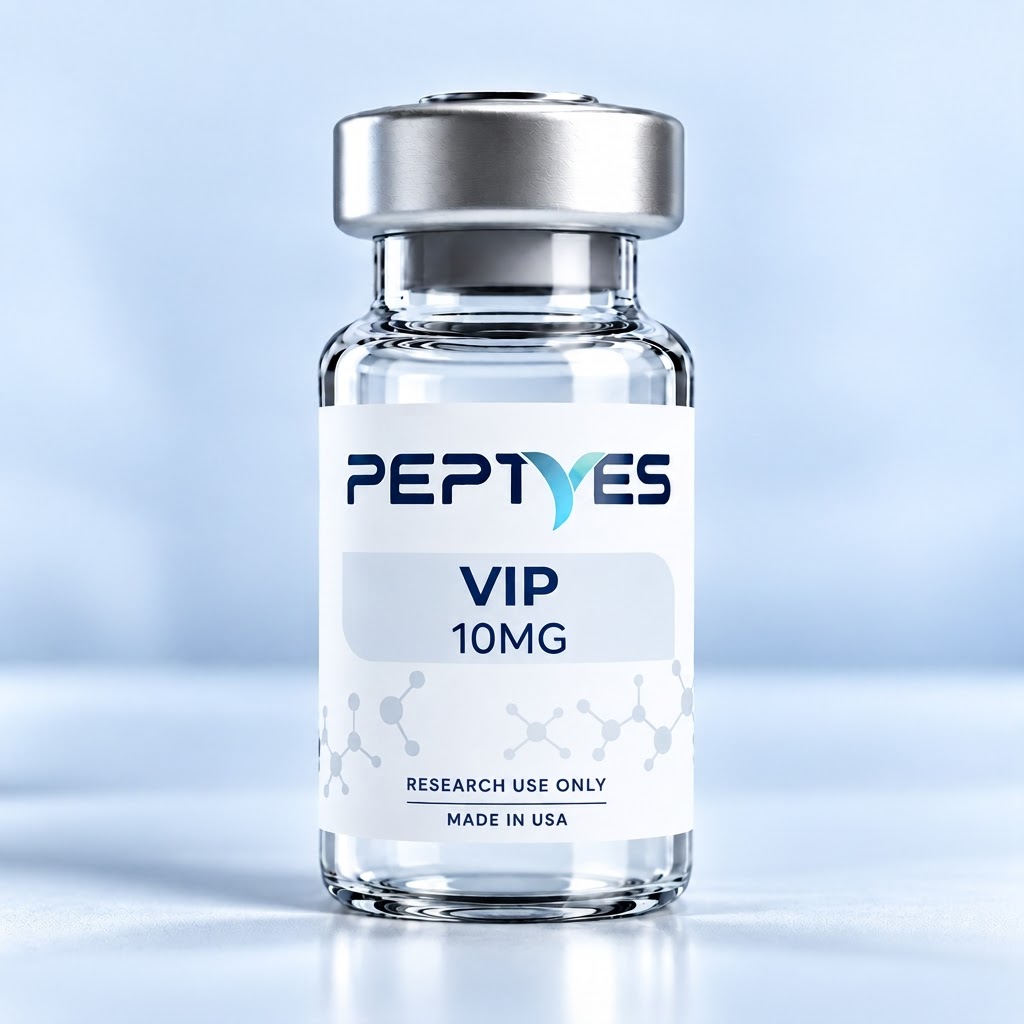
Overview
Vasoactive Intestinal Peptide is a 28-amino-acid regulatory neuropeptide first identified in intestinal tissue but since found throughout the central and peripheral nervous systems, cardiovascular system, and respiratory tract. It belongs to the secretin/glucagon peptide family and acts primarily through the class B GPCRs VPAC1 and VPAC2, whose broad tissue distribution gives VIP an unusually wide signaling footprint for a single endogenous molecule.
Mechanism of Action
VIP binding to VPAC1 and VPAC2 stimulates adenylate cyclase and raises intracellular cAMP, influencing protein kinase A and downstream gene expression programs. VPAC1 is dominant in peripheral tissues and immune cell populations while VPAC2 features prominently in neural and neuroendocrine systems — including the suprachiasmatic nucleus, where VIP signaling has been studied for its role in coordinating circadian rhythms. This receptor distribution underlies research spanning neuronal communication, vascular tone, smooth muscle responses, and immune regulation.
Specifications
- Purity: ≥99% (HPLC) with mass-spectrometry identity confirmation
- Form: Lyophilized powder
- CAS Number: 40077-57-4
- Molecular Weight: ~3326.8 g/mol
- Chemical Formula: C₁₄₇H₂₃₇N₄₃O₄₃S
- Synonyms: Vasoactive Intestinal Polypeptide, VIP-28
Research Applications
- VPAC1 and VPAC2 receptor research
- Circadian rhythm and suprachiasmatic signaling
- Vascular and smooth muscle signaling
- Immune and inflammatory regulation
- cAMP signaling pathway studies