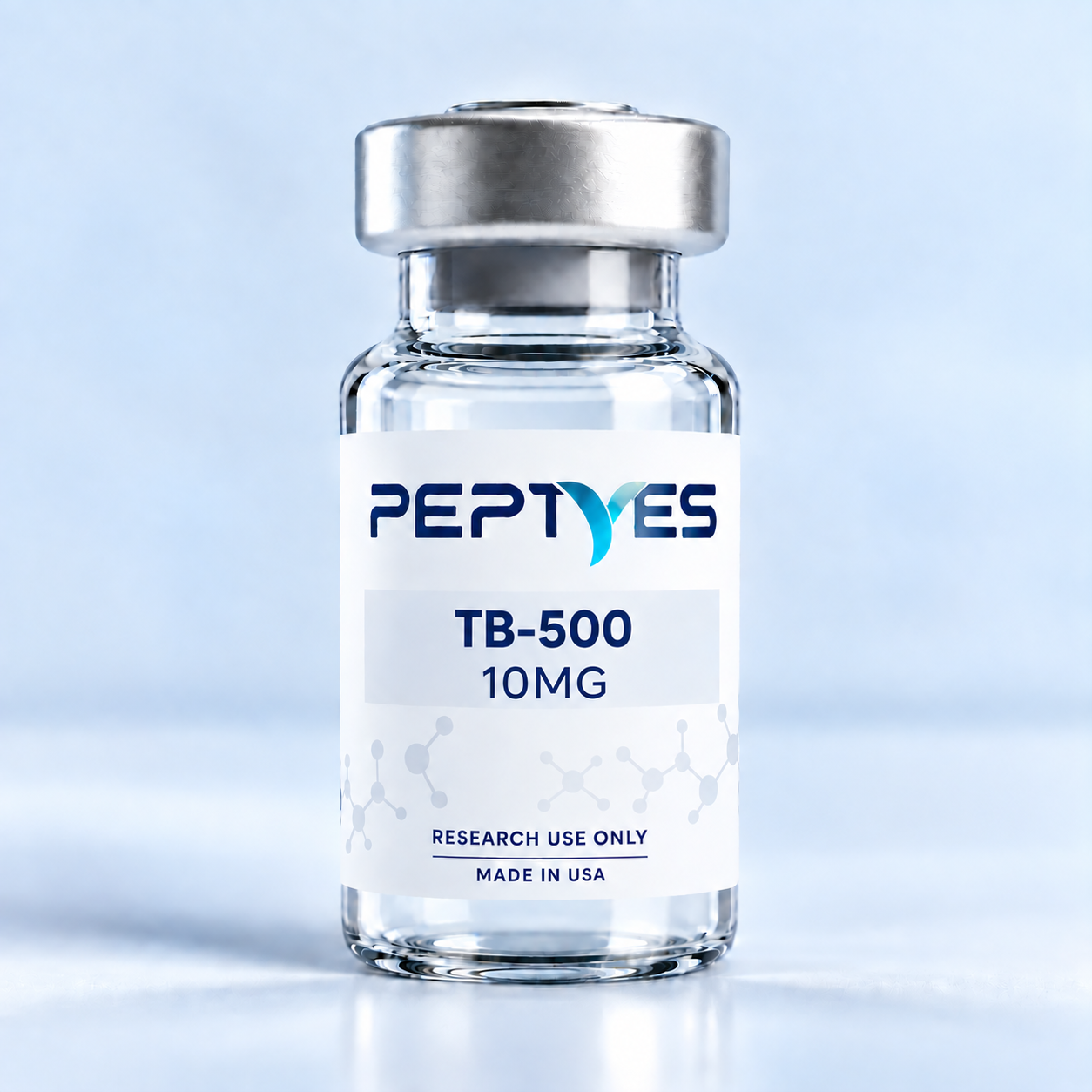
Overview
TB-500 is a synthetic version of thymosin beta-4, a 43-amino-acid peptide central to cell migration and repair biology. Its mechanistic profile is unusual in spanning two distinct routes: the intact peptide regulates actin dynamics and drives VEGF-independent angiogenic signaling, while its Ac-SDKP cleavage product carries an independent anti-inflammatory arm — making TB-500 a dual-mechanism tool compound for tissue remodeling research.
Mechanism of Action
The intact peptide sequesters G-actin monomers through its LKKTETQ active domain, shifting the monomer-to-filament actin ratio and facilitating cytoskeletal reorganization and directional cell migration in wound-edge assays. Its angiogenic signaling runs through integrin αvβ3 engagement and downstream Akt-eNOS activation — a route confirmed to remain functional under VEGF-blocked conditions, and therefore pharmacologically separable from VEGF-dependent compounds like BPC-157. Meanwhile, Ac-SDKP released by physiological cleavage independently inhibits NF-κB-dependent pro-inflammatory gene expression in epithelial and renal preparations.
Specifications
- Purity: ≥99% (HPLC) with mass-spectrometry identity confirmation
- Form: Lyophilized powder
- CAS Number: 77591-33-4
- Molecular Weight: ~4963 g/mol
- Chemical Formula: C₂₁₂H₃₅₀N₅₆O₇₈S
- Synonyms: Thymosin Beta-4, Tβ4, Ac-SDKP precursor
Research Applications
- Actin dynamics and cytoskeletal reorganization studies
- VEGF-independent angiogenesis via integrin αvβ3
- Cell migration and wound-edge assay models
- Ac-SDKP and NF-κB anti-inflammatory pathway research
- Cardiac and tissue repair signaling
- Anti-fibrotic and ECM remodeling models