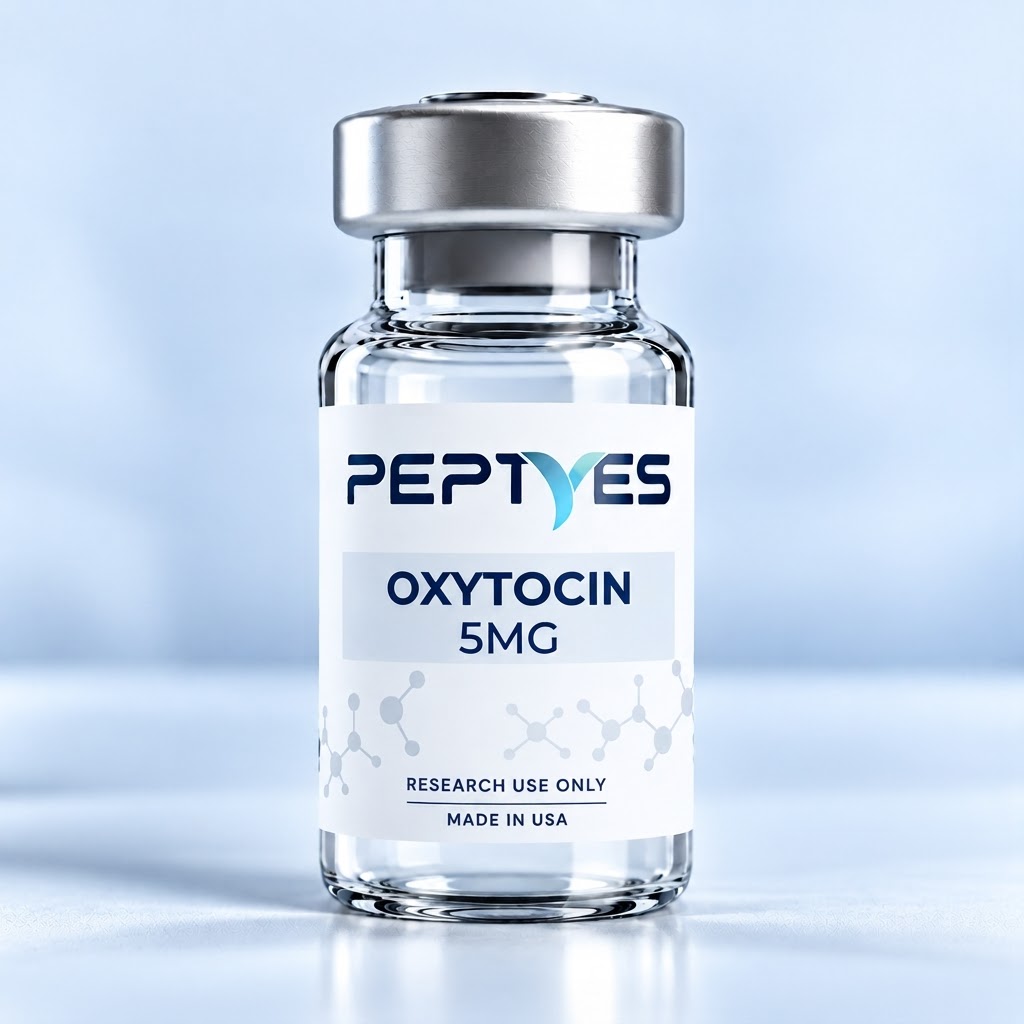
Overview
Oxytocin is a cyclic nonapeptide with a disulfide bridge between cysteines at positions 1 and 6, synthesized in hypothalamic magnocellular neurons and released from the posterior pituitary. Its sequence is among the most evolutionarily conserved in vertebrate biology — largely unchanged across hundreds of millions of years — which makes it a stable, well-characterized reference compound for receptor binding and signaling studies.
Mechanism of Action
Oxytocin acts through OXTR, a Gq/11-coupled receptor engaged across a range of tissue preparations. Receptor binding activates phospholipase C, cleaving PIP2 into IP3 and DAG — triggering intracellular calcium release and PKC activation, the primary mechanism studied in smooth muscle and myoepithelial contraction models. In CNS preparations, OXTR activation has been linked to modulation of GABAergic and dopaminergic signaling and HPA-axis stress response dynamics, and preclinical models document measurable changes in autonomic nervous system markers.
Specifications
- Purity: ≥99% (HPLC) with mass-spectrometry identity confirmation
- Form: Lyophilized powder
- CAS Number: 50-56-6
- Molecular Weight: 1007.19 g/mol
- Chemical Formula: C₄₃H₆₆N₁₂O₁₂S₂
- Synonyms: OXT, alpha-Hypophamine, Oxytocin acetate
Research Applications
- OXTR receptor biology and calcium signaling
- Smooth muscle and myoepithelial contraction models
- CNS pathway modulation
- Stress response and HPA-axis signaling
- Autonomic nervous system research