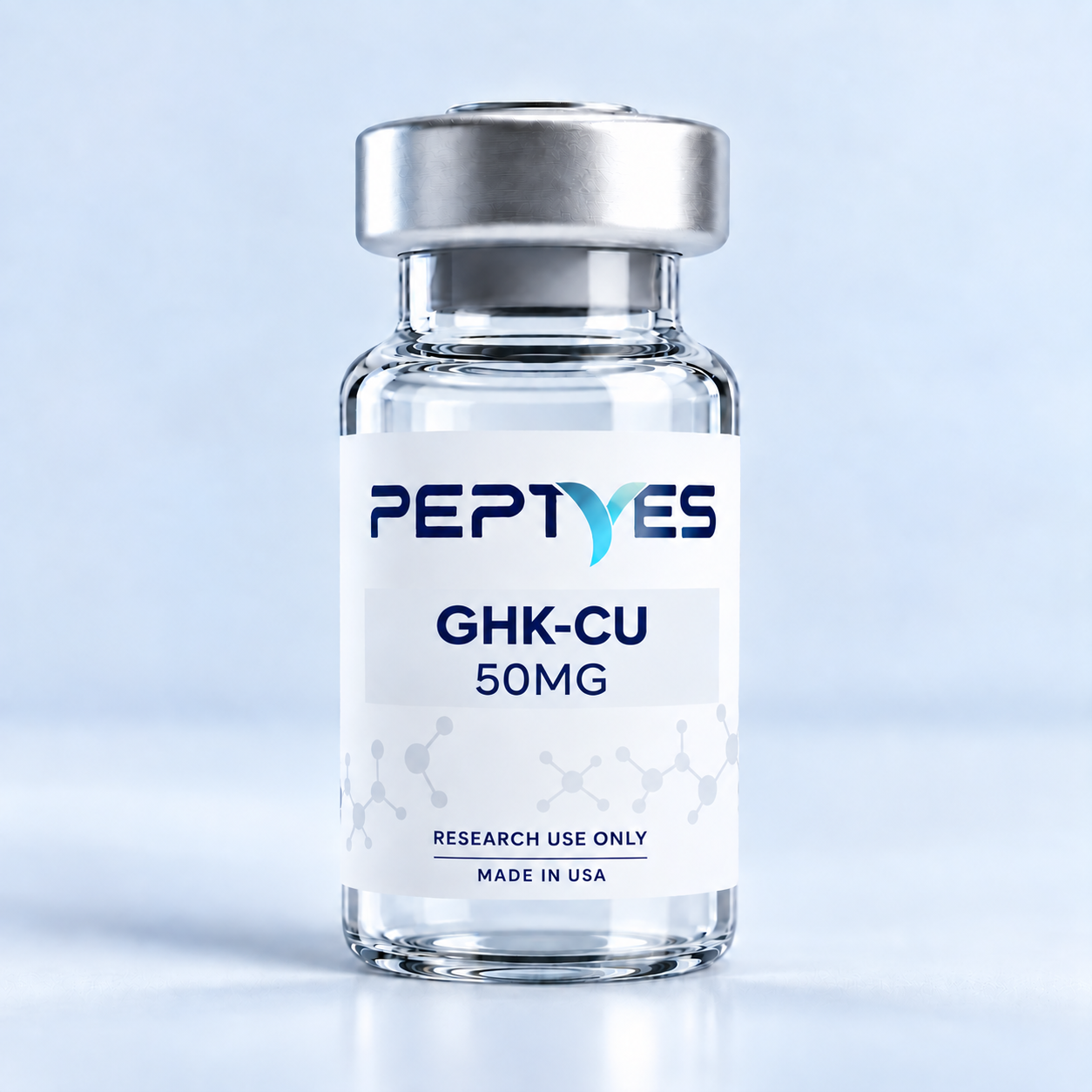
Overview
GHK-Cu is the copper complex of the tripeptide glycyl-L-histidyl-L-lysine, first isolated from human plasma in 1973. It is not a single-pathway receptor agonist: gene array analysis shows it modulates the expression of thousands of genes in human dermal fibroblast preparations, spanning collagen synthesis, matrix remodeling balance, inflammatory suppression, and antioxidant response — which has led researchers to describe it as a broad tissue-reset signal.
Mechanism of Action
In fibroblast preparations at nanomolar to low micromolar concentrations, GHK-Cu simultaneously upregulates collagen type I, III, and V synthesis genes, shifts MMP/TIMP expression toward balanced matrix remodeling, raises antioxidant response genes including SOD1 and glutathione peroxidase, and suppresses TNF-α and IL-6 pathway expression. It also performs a dual copper role — delivering Cu²⁺ to copper-dependent enzymes such as lysyl oxidase, essential for collagen and elastin cross-linking, while chelating redox-active free copper that would otherwise catalyze oxidative damage.
Specifications
- Purity: ≥99% (HPLC) with mass-spectrometry identity confirmation
- Form: Lyophilized powder
- CAS Number: 49557-75-7
- Molecular Weight: 403.93 Da
- Chemical Formula: C₁₄H₂₃CuN₆O₄
- Synonyms: Copper Tripeptide-1, Copper Peptide, GHK:Cu²⁺
Research Applications
- Collagen synthesis and ECM gene expression studies
- MMP/TIMP matrix remodeling balance research
- Copper-dependent lysyl oxidase cross-linking studies
- Antioxidant gene network and SOD1 upregulation
- Free copper chelation and redox studies
- Neuroprotective and lipid peroxidation models