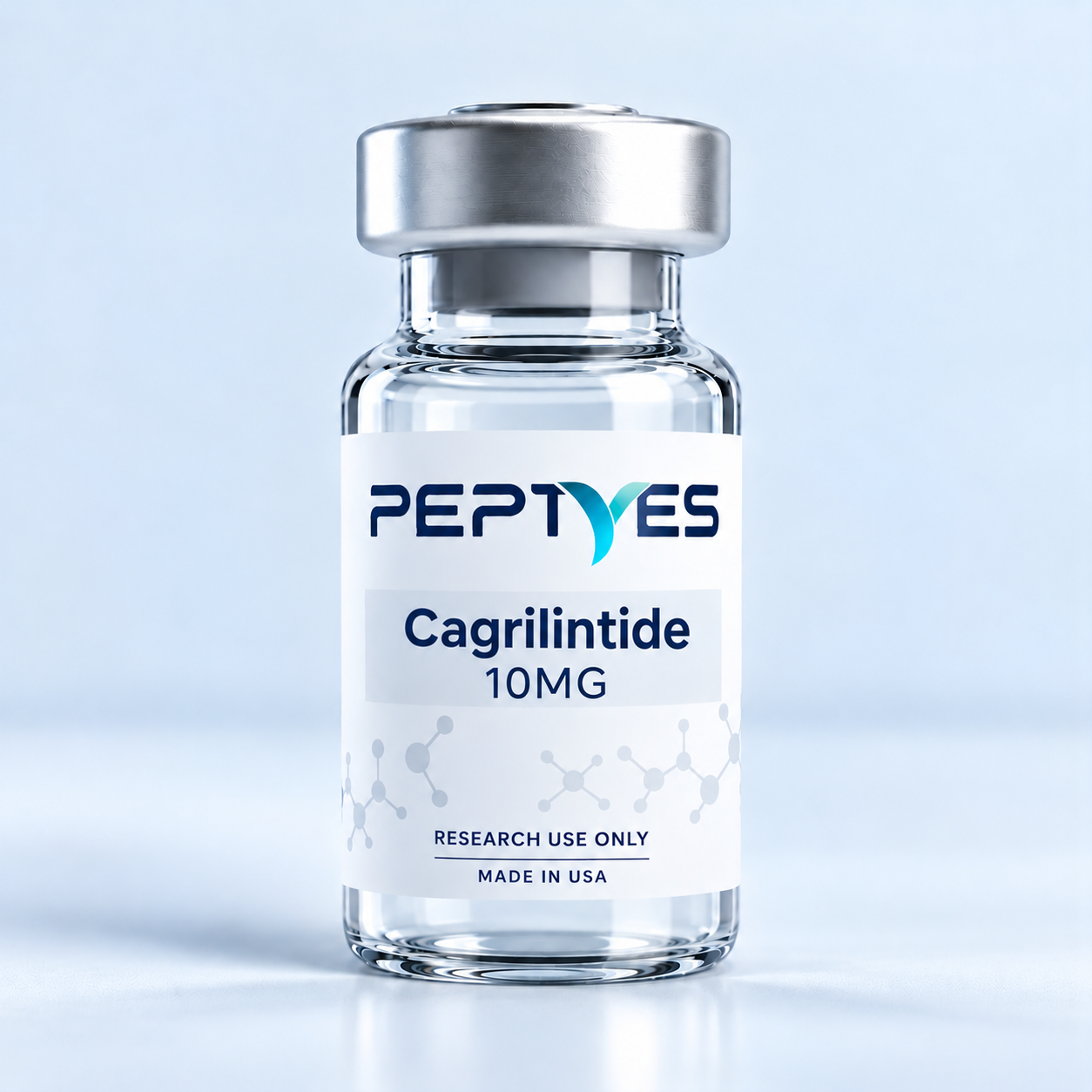
Overview
Cagrilintide belongs to a structurally distinct class of metabolic peptides — the amylin mimetics — which operate through a receptor pathway entirely separate from the incretin axis. Where GLP-1 and GIP agonists drive pancreatic insulin signaling, amylin receptor activation works primarily through hypothalamic and brainstem circuits governing satiety, gastric motility, and glucagon suppression. Its fatty-acid-acylated structure produces a long-acting profile well suited to sustained receptor occupancy studies.
Mechanism of Action
Cagrilintide binds amylin receptors — heterodimeric complexes of the calcitonin receptor (CTR) paired with RAMP1, RAMP2, or RAMP3 — expressed across hypothalamic, brainstem, and peripheral preparations. Receptor engagement activates Gs-coupled cAMP signaling, with downstream effects on neuronal activity patterns associated with satiety and food intake regulation. In gastric preparations, CTR/RAMP activation has been associated with measurable changes in motility signaling, and in pancreatic alpha-cell preparations with glucagon suppression. The acylation-mediated extended half-life distinguishes it from native amylin's rapid clearance.
Specifications
- Purity: ≥99% (HPLC) with mass-spectrometry identity confirmation
- Form: Lyophilized powder
- CAS Number: 1415456-99-3
- Molecular Weight: ~4409.0 g/mol
- Chemical Formula: C₁₉₄H₃₁₂N₅₄O₅₉S₂
- Synonyms: AM833, long-acting amylin analog
Research Applications
- Amylin receptor (CTR/RAMP) biology
- Satiety and food intake signaling models
- Gastric motility pathway studies
- Glucagon suppression modeling
- Long-acting analog pharmacology
- RAMP isoform selectivity research